What Is Acute Stress Reaction?
What Is Acute Stress Reaction?
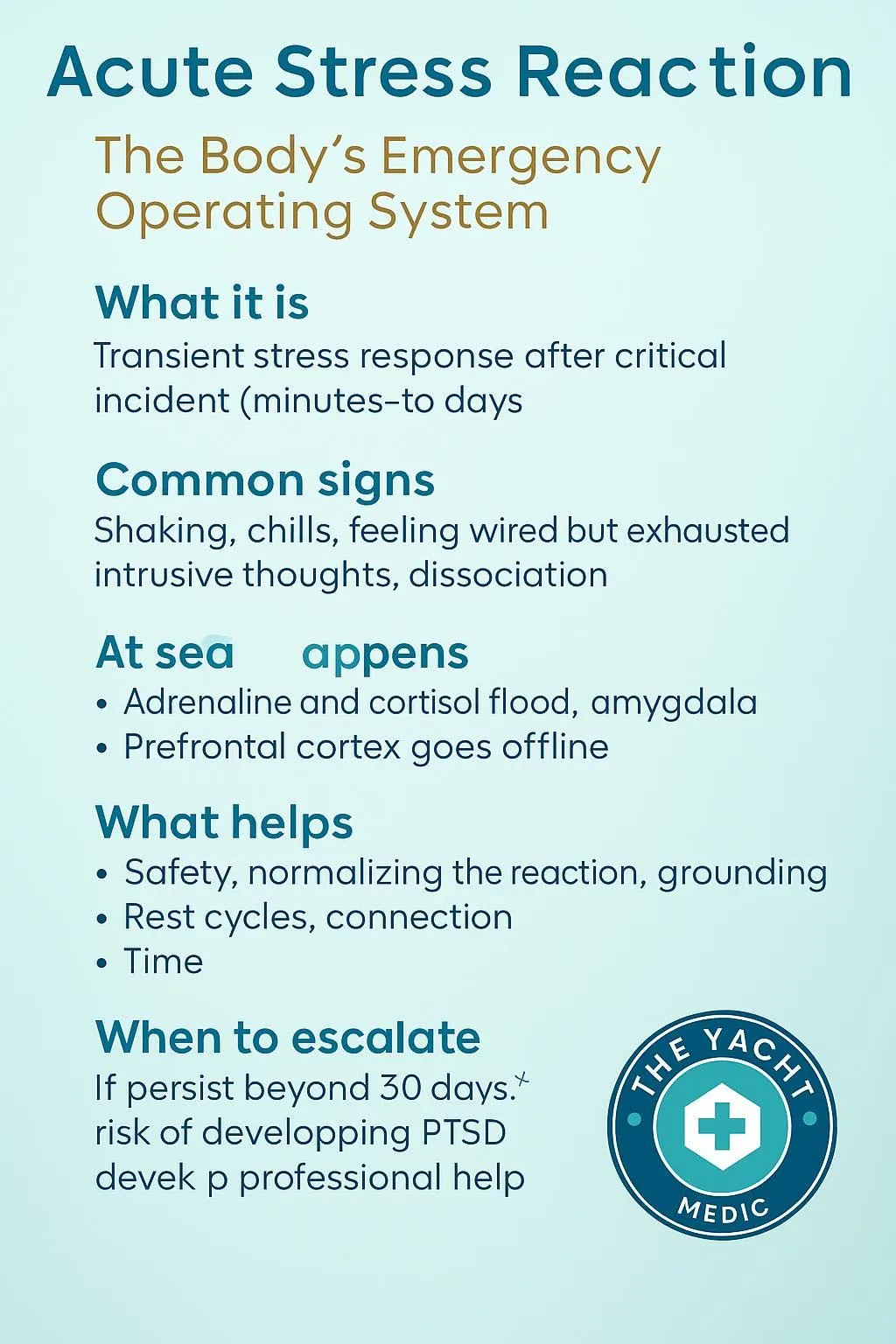
The World Health Organization defines Acute Stress Reaction (ASR) as a transient response to exceptional stress, arising within minutes to hours and usually resolving within days.
Acute Stress Disorder (ASD) is for symptoms lasting from 3 to 30 days. If symptoms persist beyond a month, the diagnosis shifts to Post-Traumatic Stress Disorder (PTSD).
Think of ASR as the body’s “emergency operating system.” It mobilises everything to keep you alive — even after the danger has passed.
.
.
What Happens in the Body
• Adrenaline & noradrenaline flood — heart rate spikes, muscles tremble, pupils dilate.
• Cortisol release — fuels energy, keeps you hyper-alert.
• Blood shunting — away from skin and gut to heart, lungs, and muscles (cold, clammy hands).
• Autonomic chaos — sympathetic system hits the accelerator; parasympathetic can’t find the brake.
Neurologically, the amygdala (threat detector) hijacks the system, while the prefrontal cortex (logic, planning) goes offline. You’re in survival mode, not reasoning mode.
.
.
At Sea: What It Looks Like:
• The stewardess who can’t stop shaking hours after the resuscitation attempt.
• The deckhand pacing the dock at 3am, replaying every second of a MOB.
• The captain who bursts into tears in the wheelhouse after holding it together for the crew.
Common signs:
• Shaking, chills, cold skin
• Palpitations, dizziness, breathlessness
• Hypervigilance, restlessness
• Emotional swings: tearful, irritable, numb
• Transient dissociation: feeling detached or unreal, as if watching events from outside the body
• Intrusive memories or flashbacks
• Insomnia or bone-deep exhaustion
.
.
What Helps (Psychological First Aid)
1. Safety first. Create physical and psychological safety — quiet space, warmth, hydration, food.
2. Normalize it. Say the words: “This is an acute stress reaction. It’s the body’s survival mode. You’re not broken.”
3. Ground the body. Box breathing, prayer, orienting techniques (naming five things you see, hear, feel). Walk barefoot on deck or shore.
4. Short recovery cycles. Even 20-minute naps or rest periods help reset the system.
5. Connection. Talk, debrief, sit with someone. Trauma thrives in silence.
6. Time. Most reactions fade in days. If symptoms persist beyond 3 days but less than 30 → this may be Acute Stress Disorder (DSM). Beyond 30 days → seek professional help for possible PTSD.
.
.
Leadership at Sea
Captains, officers, medics — you will see acute stress reaction in your crew, and often in yourselves.
Your role isn’t to snap anyone out of it. It’s to recognize it, name it, normalize it, and support recovery.
One simple sentence can change everything:
“Shaking, crying, feeling wired or numb — this is a normal acute stress reaction. Let’s get you warm, fed, and grounded.”
That moment prevents shame — and can stop a transient stress reaction from embedding into long-term trauma.
.
.
Acute Stress Reaction is the storm inside after the storm outside. It’s your body’s way of saying: you are alive — now survive.
Because resilience at sea isn’t about being unshaken.
It’s about knowing what happens when you are — and how to come back stronger.
References
• World Health Organization. (2019). International Classification of Diseases, 11th Revision (ICD-11).https://icd.who.int/
• American Psychiatric Association. (2013). Diagnostic and Statistical Manual of Mental Disorders (5th ed.).Arlington, VA: American Psychiatric Publishing.
• Bryant, R. A. (2010). Acute stress disorder as a predictor of posttraumatic stress disorder: A systematic review. Journal of Clinical Psychiatry, 71(2), 230–239.https://doi.org/10.4088/JCP.09r05072blu
• McFarlane, A. C. (2010). The long-term costs of traumatic stress: Intertwined physical and psychological consequences. World Psychiatry, 9(1), 3–10.https://doi.org/10.1002/j.2051-5545.2010.tb00254.x
• Everly, G. S., & Flynn, B. W. (2006). Principles and practical procedures for acute psychological first aid. International Journal of Emergency Mental Health, 8(2), 93–100.
